Nearly a third of UK employers don’t yet have a clear picture of the skills their organisation will need in the next two to three years
8 April 2026
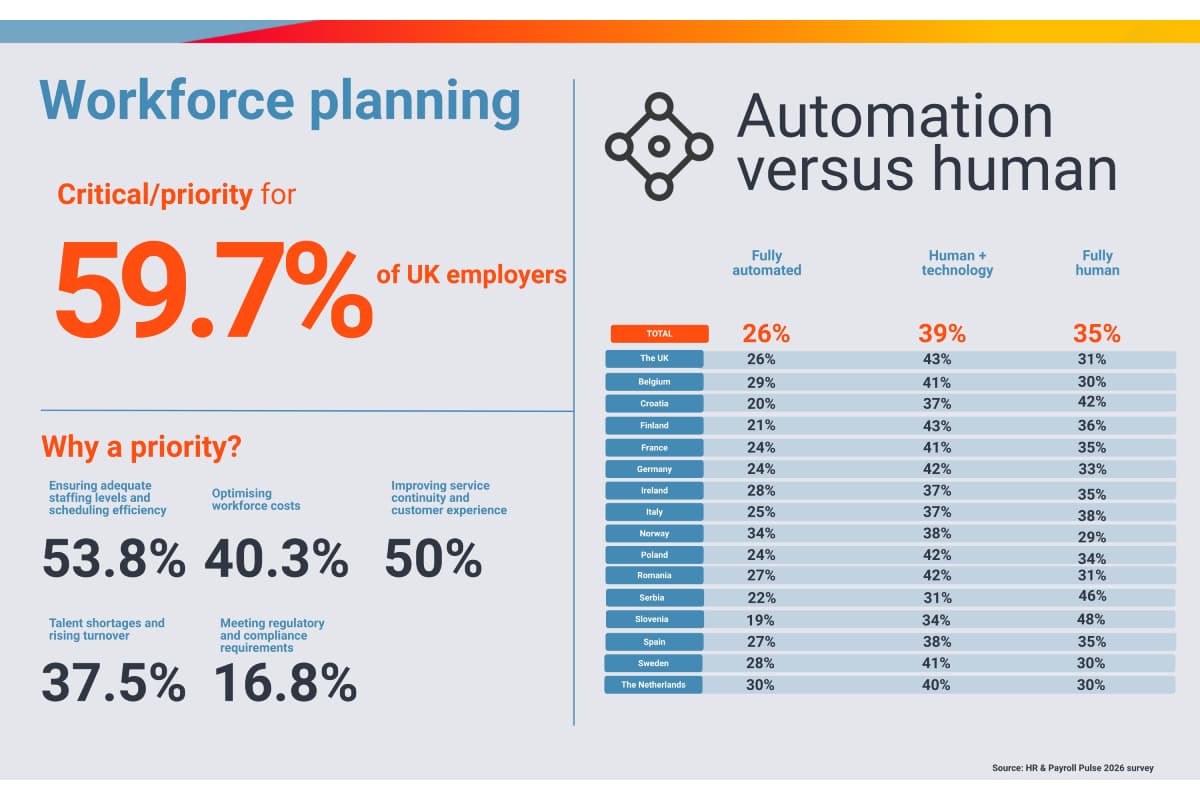
Just under 60% (59.7%) of UK organisations consider workforce planning to be a critical or high priority in 2026. Ensuring that there are enough staff to get the work done and being able to plan more efficiently is high on the agenda. This focus sits alongside the rise of automation and AI as nearly a third of UK organisations (30.4%) cite preparing for automation and AI as a driver for workforce planning, higher than the European average (26.1%). Another striking finding is that organisations are increasingly looking at skills and competencies rather than job titles when hiring staff.
This is according to new research by European HR service provider SD Worx, which surveyed 5,936 HR decision-makers and 16,500 employees in sixteen European countries, including 305 UK employers and 1,000 UK employees.
From AI to talent shortages
UK organisations are focusing more on workforce planning for a variety of reasons. First and foremost, they want to guarantee sufficient staffing levels and make planning more efficient (53.8%). This is followed by keeping personnel costs under control (40.3%) and ensuring continuity in service provision and customer experience (50.0%). Talent shortages and increasing staff turnover (37.5%) and complying with complex regulations (16.9%) complete the top five. Technological developments also play a role: 30.4% are focusing more on workforce planning to prepare for automation and AI.
Most UK organisations use a mix of job titles and skills when planning staffing
The way organisations approach workforce planning is also changing. Over half of UK organisations (54.9%) say workforce planning is based on a mix of job roles and skills. A further 24.9% say it is primarily based on skills, while 12.9% say it is primarily based on job roles/headcount. Some 7.3% say they have no structured workforce planning in place at all.
However, many are still not confident about what comes next: nearly a third (30.8%) do not yet have a clear picture of the skills their organisation will need in the next two to three years.
Employers do indeed appear to have insufficient knowledge of the skills already present within their organisation.
In the UK, 23.4% of employees disagree that their talents and potential are being fully used in their current role (while 51.1% agree). At the same time, employees show a strong appetite to develop: 64.2% agree that they are eager to learn and grow at work. However, only 45.3% agree that they see opportunities to grow or move within the organisation if they want to, and 46.2% agree that their organisation makes it easy to explore internal jobs, roles or projects that match their skills and interests.
Employees are slightly more positive when it comes to daily planning. In the UK, 66.9% agree that it is easy to coordinate their work with colleagues, and 52.7% agree that their team’s work planning process is efficient and well structured. However, many organisations still lack the necessary support: 49.7% agree that their organisation offers tools and systems for work planning.
43.2% prefer a combination of people and technology in workforce planning
According to 67.9% of UK respondents, managers today do have the necessary technology and data to plan staffing capacity effectively (higher than the European average of 60.8%).
Such systems are also gaining in importance, especially when supported by AI. Nevertheless, the human role remains important: for the time being, 25.7% believe that workforce planning should be fully automated, while 43.2% prefer a combination of humans and technology.
When it comes to time registration, 25.2% of UK employers are open to full automation with AI.

About the international employee survey
SD Worx, the leading European HR and payroll services provider, supports small and large organisations with their HR and payroll challenges. To keep its finger on the pulse of employers and employees, SD Worx regularly conducts in-depth surveys across Europe. The analysis of the latest ‘HR & Payroll Pulse’ survey offers organisations valuable insights to sharpen their HR and payroll strategy and make it future-proof.
The survey was conducted between January 27 and February 20, 2026, by the SD Worx Research Institute in 16 European countries: Belgium, Germany, Finland, France, Ireland, Italy, Croatia, the Netherlands, Norway, Poland, Romania, Serbia, Slovenia, Spain, the United Kingdom, and Sweden. A total of 5,936 HR decision-makers and 16,500 employees were surveyed. The results provide a representative picture of the labor market in each country.
About SD Worx
SD Worx believes that success starts with people. A thriving workforce doesn’t just build a thriving company, it also contributes to society. Together with its customers, SD Worx sparks successful HR that benefits work, life and society.
As the trusted leading European HR and payroll solutions provider for all organisations and workers, SD Worx delivers software, services and expertise across payroll & reward, human capital management and workforce management. SD Worx has deep roots across Europe and has been leading the way for eight decades together with its customers, employers big and small, to spark employee engagement that ignites success at the heart of their business.
About 95,000 small and large organisations across Europe place their trust in SD Worx. The almost 10,000 colleagues operate in 27 countries. SD Worx calculates the salaries of approximately 6 million employees and ranks among the top five worldwide. It achieved a revenue of EUR 1.180 billion in 2024.
More info on www.sdworx.com / Follow us via LinkedIn
Press contact